

Abstract
- The right curtain controls the light, blocks out noise, and adds warmth to the room: without it, the room feels bare, exposed, almost cold (anyone who’s ever tried leaving a window without curtains knows exactly what I mean).
- The material, the color, the way it’s hung—everything matters, everything affects how it looks and how comfortable it is: we aim for a balance between practicality, aesthetics, and a touch of whimsy (going for a heavy drape or a bold color can brighten up a gloomy Monday).
You walk into a room and find it almost empty. Yet, with a window waiting for its curtain and a bare rod, you already feel something is missing. Light floods the room, but nothing softens it. You sense the cold creeping in, the noise from the street—everything reaches you unfiltered. You think you control the atmosphere of your home, but without curtains, privacy slips away. Choose custom thermal curtains—you won’t be disappointed.
You’re looking for that missing element—the one that divides without closing off, softens without darkening, and adds without ever stealing the show: the curtain, of course. The room then comes alive; it feels warmer, softer, and sometimes even quieter. This is no trivial matter, because every fabric has its own character and effect. You no longer choose at random; from now on, it’s not just decoration—it’s almost strategic. The real secret lies in the details: you adjust, you filter, you insulate, you transform. Choose the best soundproofing today.
The role of curtains in every room of the home or office
Curtains shape the light, conceal or reveal, moderate acoustics, and, in fact, set the overall mood. You long for tranquility; you watch the light caress the plants, while the fabric regulates temperature and privacy. You know that the living room doesn’t need the same curtains as the bedroom or the office, nor the custom thermal curtains that sometimes serve as the only barrier against the cold or the urban clamor.
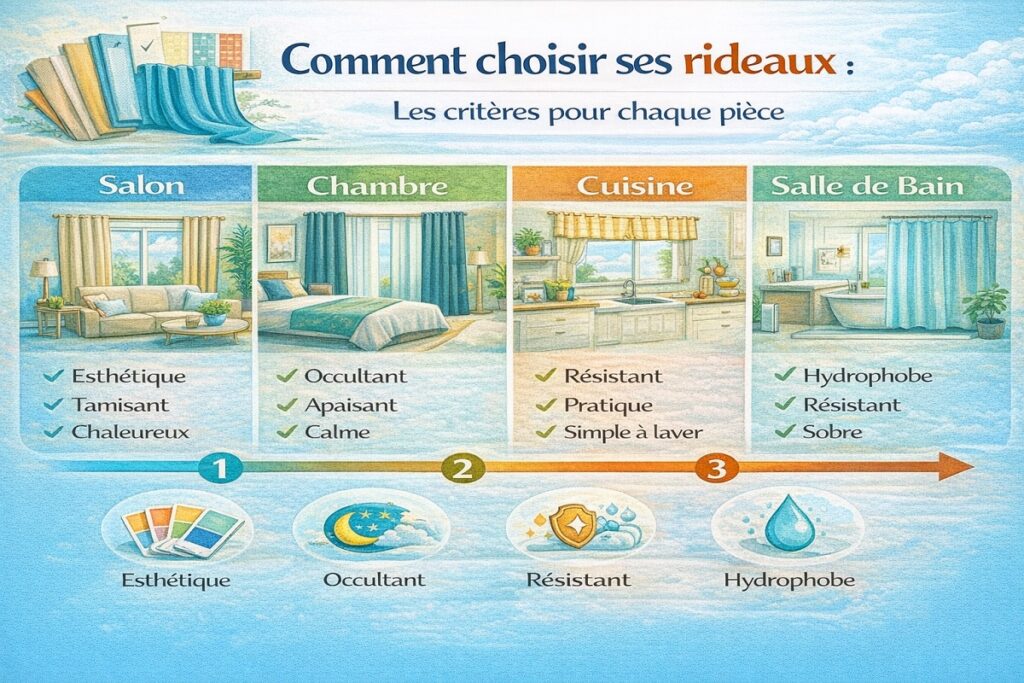
You push the boundaries, opting for sheer curtains in the living room and moisture-resistant ones in the bathroom. The living room calls for something spectacular, while a large window demands depth; you combine sheer, blackout, and graphic styles as you see fit.
Needs and priorities by space
For every room, you seek that rare balance between protection and aesthetics. The living room exudes elegance, and the lighting is adjustable. The bedroom blocks out daylight and requires reliable blackout curtains. As for the kitchen, you prioritize practicality—and sometimes a touch of playfulness. The bathroom is demanding, so you prioritize easy maintenance. In the children’s room, you avoid any risky hanging fixtures. Here is a clear, concise overview to guide you:
| Play | Curtain type | Desired effect | Recommended material |
|---|---|---|---|
| Living room | Double curtains, sheer curtains | Sieve, decorative | Linen, cotton |
| Room | Double-layered blackout curtains, heavy curtains | Darkness, isolation | Velvet, blackout, thermal lining |
| Office | Double curtains, sheer curtains | Sieve, decorative | Linen, cotton |
Comfort and aesthetic goals
Visual coherence guides every choice. You don’t hang a curtain just to hide something. You want a versatile space where you can adjust the light to your liking. Fashion inspires you; the colors of 2026 hold promise: sage green, nude, terracotta, ecru—each shade evokes a fresh atmosphere. The geometric pattern stands out boldly, transforming the dining room into a contemporary work of art. You play, you compose, without necessarily following the expected logic. A floor-to-ceiling curtain creates perspective. A heavy drape envelops the space, while a white rod draws the eye upward. The whole becomes fluid, almost ethereal.
Technical criteria for choosing the right curtains
You don’t compromise on technique. You measure, you anticipate, you adapt. The wrong width shrinks, the wrong height spoils the look, and an overlooked overhang lets in light at a wrong angle. The materials you select, the installation method—everything impacts daily life. You lean toward cotton and its natural energy, airy linen, dense velvet, or a composite fabric for insulation. The fastening affects the finish; maintenance sometimes calls for greater wisdom. You verify the compatibility of your equipment, because you refuse any ineffective compromise.
Selecting materials and fabrics
It’s almost a matter of personal style—linen for its suppleness, cotton for its softness, polyester for its durability, velvet for its elegance. You discover that every fabric has its flaws and its virtues. Velvet traps dust and requires regular vacuuming. You laugh at linen for wrinkling, but its lightness wins you over. A blackout curtain in the bedroom shields you from the neighborhood without compromising comfort.
| Subject | Benefits | Disadvantages |
|---|---|---|
| Flax | Lightweight, elegant | Crumples easily |
| Cotton | Natural, easy to wash | May shrink when washed |
| Polyester | Durable, inexpensive | Static sensitivity |
| Velvet | Thermal and decorative | Heavy, collects dust |
| Blackout | Light barrier | Not very light |
Taking measurements and selecting dimensions
The measurements determine how well your curtain will fit. Take a tape measure and mark the starting point at the top of the rod. Add about twenty centimeters to the right and left: the result is a generous, flowing drape. Calculate the height so that the fabric just grazes the floor—never more than three centimeters of excess. Custom-made? A wise choice, especially for the large picture window that anchors the living room.
Choosing colors and patterns
Color defines the room. You try ivory on the sofa, soft green on the bedroom window, and a touch of saffron against a neutral wall in your office. You refuse to compromise; sometimes you dare to take a bold color risk. You know that a room’s atmosphere depends on a well-chosen shade.
Choices for fastening and installation systems
The hardware reflects your decorative vision. Grommets for a clean look, hidden brackets for a subtle touch. Stitched pleats accentuate the structure, while rings put a modern spin on tradition. Install a sturdy rod, hang your curtains with ease, and adjust the height as needed. Everything falls into place, hangs taut, and the room quietly transforms.
Tips and inspiration by curtain type
Choosing the right curtains plays a key role in setting the mood of your home. They control the light, block out noise, create a cozy atmosphere, and add a personal touch. Whether for your home or office, here are a few tips to help you make the right choice for each type of space.
Curtains for the home
Home curtains should be both attractive and practical, while also suiting the unique characteristics of each room. They should provide comfort, privacy, and, in some cases, sound insulation. In the living room, you’ll want a curtain that brings in light and adds a touch of elegance. Choose a double curtain or a lightweight sheer made of linen or cotton that will filter the light while creating a warm atmosphere.
Curtains for the office
In a workspace, curtains play a crucial role in providing privacy, visual comfort, and, in some cases, sound insulation to help improve concentration.
Office curtains should be both practical and aesthetically pleasing. Opt for double curtains or sheer curtains made of linen or cotton to create a soft, diffused light. If you have a large picture window, choose thick curtains to ensure sound and thermal insulation. Neutral colors like gray, taupe, or off-white create a sense of calm and professionalism without disrupting the work atmosphere.
Cotton Silence Pro's Solutions for Common Mistakes
Common mistakes when choosing acoustic curtains can compromise their effectiveness, but Cotton Silence Pro offers tailored solutions to address these issues. A poor fit can reduce sound insulation, which is why we offer custom-made curtains that are perfectly tailored to your windows to maximize acoustic efficiency. Fabric selection is also crucial; standard fabrics aren’t always effective at blocking noise. Cotton Silence Pro uses technical materials like multi-layer polyester and densified cotton, specifically designed for sound insulation.
Another common mistake is improper installation. If the curtain rod or track isn’t installed correctly, the curtains may not function as effectively. That’s why we help you choose the right mounting system to ensure optimal installation. In addition, proper curtain maintenance is essential to maintaining their performance. Our curtains are designed to be easy to maintain, offering a durable solution that retains its performance over time.
Finally, it’s important not to settle for decorative curtains without considering their acoustic properties. With Cotton Silence Pro, we combine aesthetics with acoustic performance, allowing you to enjoy both visual and acoustic comfort. Choosing Cotton Silence Pro means opting for an effective and sustainable solution to reduce noise while adding an elegant touch to your interior.
Answers to Frequently Asked Questions
How do you choose the right color for your curtains?
Ah, the never-ending team brainstorming session when it comes to choosing curtain colors. A true group effort. A tip from experience: imagine an open-plan office where every curtain clashes with the carpet… a chaotic atmosphere, zero visual cohesion. The goal: to harmonize and unify the space, creating that famous “team spirit” in interior design that boosts efficiency. Not such a trivial challenge, by the way: a light color makes the room feel bigger, opens up the perspective, and lets it breathe (like a meeting where everyone speaks with one voice—magic). Conversely, dark tones, like deep blue, create a cocoon-like atmosphere and help with focus, but they can quickly make the space feel cramped, giving the break room a bunker-like vibe…
How do I know which curtains I need?
Taking measurements—that’s THE project. No more, no less. Honestly, who hasn’t grumbled about an undersized window because the team overlooked the required width? The mission here: to aim for collective success. We double the width of the window to create a sense of space and foster XXL collaboration. For a 116 cm window, we go all out with 232 cm of fabric, even if the purchasing department grumbles (the investment pays off!). We always round up—it’s like managing a schedule: it’s better to plan generously so you don’t get stuck.
How do I know what size curtains to get?
The length of a curtain is like a project deadline: you think you know it, but sometimes you’re wrong. A tip from interior design training: install the rod 15 centimeters above the window (and not otherwise). Everyone measures from the floor to the top of the window, adds 15 centimeters, and there you have the strategic length. That detail is the key to interior design leadership, the nuance that shows we’re working hand in hand: no more curtains that are too short, no more curtains dragging unsightly on the floor.