Acoustic, sound-absorbing, and soundproof curtain; noise-reducing and noise-blocking

The purpose of this article is to explain the benefits of an acoustic, sound-absorbing, and soundproof curtain.
You'll learn more about its noise-canceling and sound-dampening effects.
Why use an acoustic curtain?
Decorative elements and furniture such as sofas, rugs, carpeting, and curtains can provide acoustic comfort. The advantage of an acoustic curtain is that it is the only piece of furniture that can be placed in front of a window or a picture window. Glass, even though it provides plenty of light, is an inert material that significantly contributes to a room’s resonance. In certain settings, such as schools, open-plan offices, or standard offices, windows make up a significant portion of the “wall” surface area and should be addressed. Curtains can thus help regulate sound propagation within a room.
How can you tell if a soundproof curtain is effective?
Acoustic and soundproof curtains: how effective are they?
In the acoustic curtain market, soundproofing and acoustic insulation are often conflated.
Curtains are sometimes marketed as having both functions.
Soundproofing involves preventing outside sound from “entering” a room. Acoustic treatment involves reducing echoes and reverberation within a room.
Acoustic curtains are often sold to improve sound insulation, with noise reductions ranging from 5 to 18 dB.
A gain of 5 dB is relatively small, whereas 18 dB provides a real solution, and the difference will be clearly noticeable. For example, a standard interior door already offers sound reduction of between 18 and 27 dB.
It’s important to understand that this reduction in decibels varies depending on the frequency. Depending on your situation, it may be better to choose a curtain that performs well at mid and high frequencies. For others, however, it may be preferable to have a curtain that performs well at mid and low frequencies.
If you're looking for an effective and stylish solution to improve the acoustic comfort of your home, the Soundproof Curtain is an excellent option. Thanks to specially designed materials and advanced technology, it combines performance with design. To learn more about its features and discover models tailored to your needs, visit Soundproof Curtain.
. It is always a good idea to identify the types of noise that bother you so you can choose the best solution. To better understand this, take a look at the graph below.
In addition to reducing noise from outside to inside (sound insulation), curtains also provide sound absorption. This is often due to their construction using multiple layers of fabric. When combined with an air cavity, these materials help to dampen sound.
These two factors therefore offer a significant benefit in terms of a room’s acoustics.
However, it should be noted that curtains—even the best ones—are often used as supplementary or finishing touches in an overall design project.
This is mainly becausea curtain only works when it is closed in front of the window.
However, in spaces with many windows or floor-to-ceiling windows, the goal is to let in more light and open up to the outside… which is the exact opposite of what curtains are meant to do.
Effectiveness: Determining the Best Sound Barrier
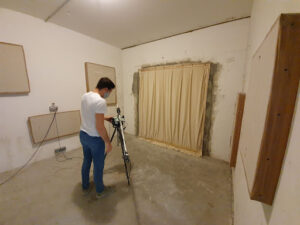
Acoustic curtains reduce noise through two main operating principles.
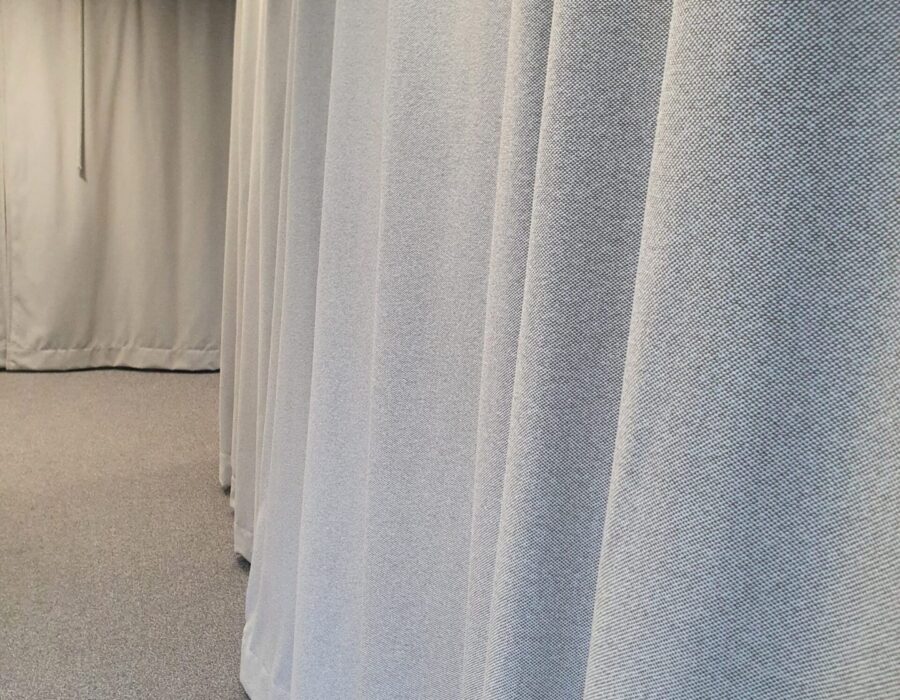
First, in terms of sound absorption: the curtain is made of thick, dense fabric, which absorbs sound due to its thickness and the air pocket it creates.
The second is based on the mass-spring effect: the curtain consists of successive layers of different materials that work together to optimize sound absorption. One layer absorbs sound, another reflects it…
The following points should be noted:
The thicker the curtain, the better it works
The farther the curtain is from the support, the better it works
The more surface area the curtain covers, the better it works
There are several types of acoustic curtains:
The conventional curtain
The Japanese-style fabric curtain
Curtains that provide good soundproofing are often:
Techniques consisting of multiple layers.
Blackout
Thick
Heavy
Away from the wall
Made of natural felt
Velvet
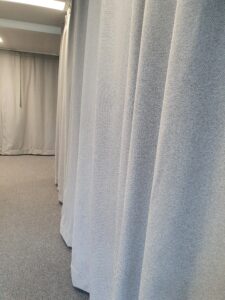
Heavy-duty soundproof curtain
As mentioned earlier, the thickness of the curtain will affect its sound-absorbing properties. It is therefore bestto use a thick curtain and pay attention to the material used. Test reports can also provide additional insight into the product’s quality. However, they should be examined with particular care. We will return to this later.
Soundproof and noise-reducing curtains: how much noise reduction can you expect (12 dB, 20 dB, 21 dB, or 30 dB)?
A relatively basic curtain will provide a noise reduction of about 5 to 7 dB. This corresponds to the standard reduction achieved by a so-called acoustic curtain. These curtains are either relatively thick or made of a thin layer of “metallized” fabric, similar to garage insulation. A higher-quality curtain will offer sound reduction between 12 and 18 dB. These curtains are constructed with multiple layers. Some are very heavy and thick because they are made of high-quality fabrics combined with felt or batting. Others, which are the result of special attention to detail, can remain lightweight thanks to advanced material research and technical innovation. They are made of heavy textiles, coatings, metallized sheets, and fleece. 5- and 7-layer soundproof curtains: acoustic and noise-reduction performance Technical, acoustic, and noise-reduction curtains can thus incorporate 5 or even 7 layers!
The more layers the curtain has, the more effective it will be (depending, of course, on the materials used). However, it will be heavier and, as a result, less easy to handle.
In addition, because of its properties, a noise-reducing curtain will also significantly reduce reverberation in the room. However, in this case, the curtain must be kept closed at all times!
The Uses of a Soundproof and Acoustic Curtain
Acoustics are important in many situations. In this sense, curtains can be useful for both homes and businesses. Curtains for soundproofing As explained earlier, curtains provide additional soundproofing. This means they can help you get a better night’s sleep if you live near a road. However, they won’t stop you from hearing the party going on at your neighbor’s house.
Home theater acoustic curtain
Acoustic curtain for a studio
An acoustic curtain is also very useful in a studio:
Whether it's an apartment
Or whether it's a music studio
In fact, acoustics offers numerous benefits for both of these environments.
Velvet stage sound curtain
Rubber acoustic curtain
As we will see later, the number of layers will affect the curtain’s performance. A basic rubber acoustic curtain, therefore, will be of little use.
Soundproof curtain for room partitioning
Acoustic, soundproof, and noise-reducing curtain for entry doors
Industrial noise barrier
Homemade soundproof curtain
Acoustic curtain for a bedroom
As mentioned earlier, an acoustic curtain is the perfect way to improve your sleep.
Professional acoustic curtain
The price of soundproof fabric per yard
As with many acoustic products, thinking in terms of price per square meter is of little use. It is better to consider other factors, particularly acoustic performance per square meter, when comparing products.
On top of that, just like an acoustic panel, an acoustic curtain is more technically complex than it appears. Having one custom-made by an upholsterer would cost you significantly more than buying a ready-made one.
Affordable soundproof curtains: How much should you expect to pay?
The price will depend on the results you’re looking for. As is often the case, curtains are available at every price point. The least expensive options range from €90 to €129. However, professionals don’t generally recommend them because they aren’t very effective. A high-performance acoustic curtain can cost between €250 and €600 per panel.
Alternatives to soundproof curtains from Galon, Moondream, IKEA, Leroy Merlin, Castorama, and Amazon As mentioned earlier, the number of layers and the construction of a curtain will affect its performance. The problem is that most of these sites offer basic curtains. If you look at most customer reviews, you’ll see thatthe effectiveness of these products is quite mixed. This is reflected in the price: it is indeed low. As is the case in many markets, you therefore need to spend a certain amount to get a decent result.
Similarly, if you’re purchasing these types of products as part of a larger project—whether for soundproofing or acoustic treatment— proper installation is crucial. It requires expert advice, which you won’t find on these websites.
At Cotton Silence: The solution for optimal acoustic performance
At Cotton Silence, we offer high-performance solutions with our soundproof curtains, which combine advanced technology, modern design, and eco-friendly manufacturing. Our products deliver proven effectiveness thanks to their multi-layered materials, providing sound reduction of up to 30 dB—ideal for all types of environments.
Available in a variety of colors, our curtains blend seamlessly into your decor while providing optimal soundproofing. Installation is quick and easy, requiring no special tools.
Finally, our commitment to quality and the environment makes our products a sustainable and high-performance choice. To learn more about our noise-reducing curtain, check out our solutions and find the perfect one for your space.
Limitations of the acoustic curtain
Curtains and soundproofing
We addressed this issue at the beginning of this article. As mentioned, a curtain offers only limited sound insulation.
The problem with an open curtain
The problem with acoustic curtains is that they are often left open. However, they are inevitably more effective when closed, as they cover a large area. This is especially true since, in most cases, they cover highly reverberant surfaces (such as floor-to-ceiling windows). These surfaces will have a negative impact on your acoustics.
Test reports
It is important to be cautious about the sound pressure levels of acoustic curtains. You should also be careful about the methods used to calculate noise reduction with these curtains. In fact, many products are marketed with an “NRC” rating. It is presented in the same way as the “Aw” rating. However, technically, they are not the same thing.
Ideally, therefore, you should have a complete alpha-Sabine test report, broken down by frequency. It is therefore preferable to calculate the gain index in terms of the reduction in RT (reverberation time) with the curtains open. In practice, they are more often open than closed, so the treated surface area is not the same.
In addition, as mentioned earlier, a curtain must be closed to be fully effective.
Also keep in mind that sheer, see-through curtains don’t work. As a result, you lose the appeal of your windows.
In conclusion, acoustic, soundproof, and noise-reducing curtains: what should we make of them?
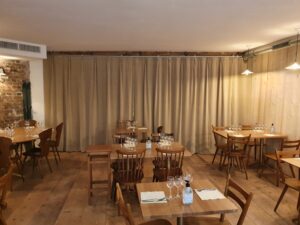
Soundproof curtains can therefore be useful for improving your acoustics. To be effective, they must be “open,” that is, unfolded. They can be used in many situations. Their performance depends on their thickness and how they are installed. While test reports are a useful indicator for forming an opinion, it is essential to examine the testing method to ensure that the performance results have not been exaggerated by the testing process.